Global Agent OS Ecosystem 2026 — seven layers, six regions, and where LEAP fits
A radar of the 2026 Agent OS war: 7 structural insights · 7 stack layers · 6 regional ecosystems · 6 avoidance patterns — distilled from the LEAP AI Research Subagent internal map, with 7 custom diagrams.
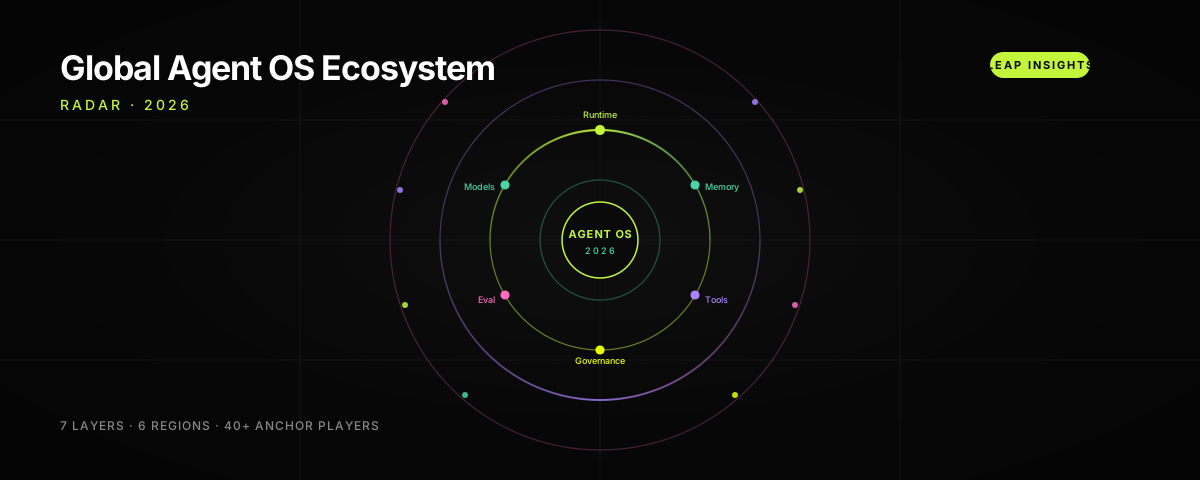
Our internal Agent OS radar, rewritten as a public blog post. Seven structural insights, seven stack layers, six regional ecosystems, six avoidance patterns — and where LEAP's AI Commerce / GEO Agent OS slots into the global map. With seven custom diagrams.
2026 is the year 'Agent OS' stops being a marketing label and starts being infrastructure that enterprise buyers procure with the same scrutiny they apply to a database or an identity provider. This post is the public version of our internal LEAP Global Agent OS Ecosystem Map (LEAP AI Research Subagent, 2026-05-26) — distilled into seven structural insights, seven stack layers, six regional ecosystems, and six avoidance patterns. It closes with where LEAP's AI Commerce / GEO Agent OS sits inside the global map, and which layers we deliberately build versus integrate.
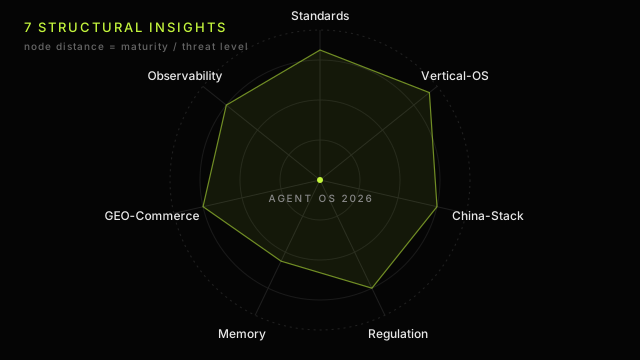
2026 is the year Agent OS stops being a concept and starts being infrastructure — and seven structural shifts now determine who owns the stack. First, the runtime boundary is being redrawn by three players in parallel: OpenAI Agents SDK, Anthropic MCP, and Google ADK/A2A, with MCP already the de facto Agent-to-Tool standard and no single winner crowned. Second, the leap from point solution to OS depends on exactly one combination — closed-loop execution plus vertical data rights — proven by Sierra (ARR $150M+, 40%+ of the Fortune 50) and Harvey (ARR $195M, $11B valuation). Third, China is building a parallel Agent OS stack via ByteDance Coze, Alibaba Bailian and DeepSeek, but the cross-border GEO and AI-commerce execution layer remains essentially empty.
Fourth, regional regulation is hardening into a moat: Singapore IMDA shipped the world's first Agentic AI governance framework in January 2026, the EU AI Act reaches full effect in August, and Mistral × SAP are already operationalizing sovereign AI in Europe. Fifth, Agent memory is now a first-class architectural component — Mem0 hits 92.5 on LoCoMo and Zep leads in production with bi-temporal knowledge graphs, meaning whatever enters an agent's persistent memory keeps shaping recommendations. Sixth, GEO × AI Commerce is the one unclaimed lane in the global Agent OS map: Amazon Rufus, Profound, Athena HQ and Addlly AI all circle the space, but none yet closes a cross-LLM, cross-channel, cross-border loop. Seventh, observability — LangSmith, Braintrust, Langfuse, Arize Phoenix — has graduated from tooling to enterprise procurement gate, because CIOs now demand explainability, auditable logs and cost tracing before any Agent OS purchase clears.
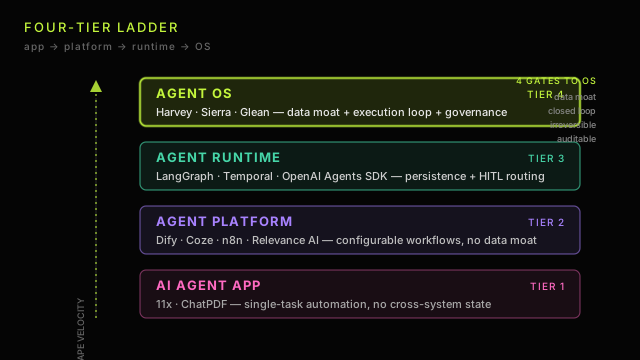
The label "Agent OS" is now stretched across everything from a Notion add-on to Sierra's contact-center backbone, so the first useful move is to draw a four-tier ladder. Tier 1 is the AI Agent App — single-task automation with no cross-system state, like 11x's SDR bot or ChatPDF. Tier 2 is the Agent Platform — Dify, Coze, n8n, Relevance AI — where developers can configure multi-tool workflows but no proprietary data sits underneath. Tier 3 is the Agent Runtime — LangGraph, Temporal, the OpenAI Agents SDK — adding checkpoint persistence, deterministic routing, and Human-in-the-Loop. Tier 4, the actual Agent OS, only earns the name when four gates are simultaneously cleared: a data-permission moat competitors cannot legally replicate, an execution closed loop that finishes the task (refund, contract draft, merged PR) rather than answering about it, irreversible embedding deep enough to make switching cost prohibitive, and a governance surface a compliance team will sign off on. Miss any one and the product is just a better chatbot. Harvey owns the legal slice, Sierra the CX slice, Glean the internal-knowledge slice — and no horizontal Agent OS exists yet.
Running LEAP's own stack through the same test produces a deliberate definition: AI Commerce / GEO Agent OS equals Search Visibility plus Commerce Workflow plus Content Execution plus LLM, Rufus, and social-AI recommendation plus an Attribution Flywheel that closes citation to click to conversion to repurchase. Each of the four gates clears against commerce-native data rather than legal corpora or CRM transcripts: the moat is brand-owned product, review, and creator data; the closed loop runs product-page edits, Reddit and PR distribution, and attribution; the embedding sits inside merchandising and growth workflows that nobody rips out mid-quarter; the audit surface is the citation and attribution log. The strategic consequence is that LEAP never has to fight Harvey, Sierra, or Glean for the same buyer — it occupies the AI Commerce execution layer that none of them is built to serve, and that no horizontal Agent OS has yet claimed.
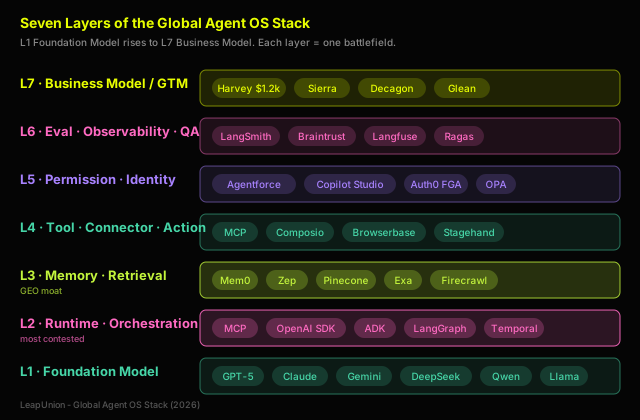
The clearest way to read the 2026 Agent OS market is not as one giant arena but as seven stacked battlefields, each with its own winners, pricing logic, and switching costs. L1 Foundation Model is the most visible fight but already commoditizing — GPT-5 and Claude anchor the frontier while DeepSeek and Qwen race the cost curve down. L2 Agent Runtime & Orchestration is where every framework is currently bleeding (OpenAI Agents SDK and LangGraph). L3 Memory · Retrieval · Knowledge is where durable IP is quietly accumulating (Mem0 and Pinecone). L4 Tool · Connector · Action is consolidating around protocols (MCP and Composio). L5 Permission · Identity · Governance is where enterprise gatekeeping happens (Salesforce Agentforce and Microsoft Copilot Studio). L6 Eval · Observability · QA is the trust layer (LangSmith and Langfuse). L7 Business Model / GTM is where everything is repriced (Harvey's $1,200/seat and Sierra's outcome-based contracts).
Two layers deserve special attention. L2 Runtime is the loudest war: MCP has become the de facto USB-C of AI tools, OpenAI Agents SDK ships the cleanest handoff model, Google's ADK+A2A bets on multi-agent protocols, LangGraph dominates stateful workflows, and Temporal — fresh off a $300M Series D at a $5B valuation — owns long-running reliability. No one will win all five sub-categories; buyers will end up running two or three side-by-side for years. The layer secretly winning, though, is L3 Memory. Mem0's April 2026 algorithm scored 92.5 on LoCoMo while retrieving with roughly 6,900 tokens — an order of magnitude leaner than naive RAG — and it now integrates 21 frameworks plus 20 vector stores. Whoever owns an agent's persistent memory owns its behavior, its personalization, and ultimately its GEO moat, because that memory becomes the substrate AI search engines cite back.
The layer where competition will finalize last is L7 Business Model. Per-seat SaaS is sliding into outcome-based pricing — Harvey still charges $1,200 per lawyer per month, but Sierra and Decagon already bill per resolved ticket, and the gap between those models is where the next decade of margin lives. For buyers this means one thing: stop comparing agent vendors on feature parity and start comparing them on which layer they're trying to own, because that determines whether you're paying for software, infrastructure, or a guaranteed business outcome.
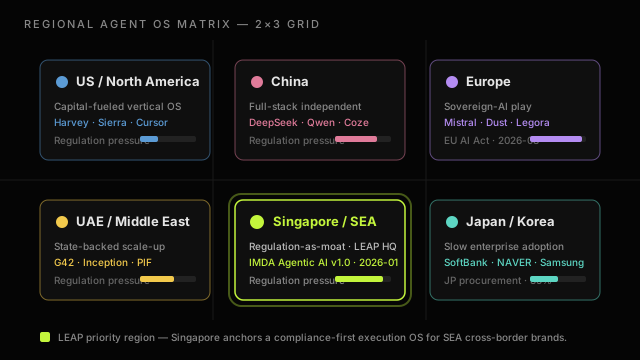
The global Agent OS stack is no longer bifurcating along language lines — it is bifurcating along regulatory and ecosystem lines. A model trained in Paris and a model trained in Hangzhou can both speak fluent English, but they cannot both be deployed under the EU AI Act, the Cyberspace Administration of China's filing regime, and Singapore's IMDA Agentic AI framework with the same architecture. What looks from the outside like one global race is in fact six parallel stacks, each shaped by who funds it, who regulates it, and which enterprise buyers will actually sign a contract. Reading the regional matrix correctly is now a prerequisite for any cross-border Agent OS strategy.
Six regions, six distinct postures. US / North America runs a capital-fueled vertical OS playbook — Harvey at $11B, Sierra at $15.8B, Glean at $7.2B, Cursor around $50B — with light federal regulation and Fortune 50 budgets absorbing the cost curve. China is the only full-stack independent ecosystem, anchored by DeepSeek V4, Qwen with 1B+ downloads, and the Coze/Dify runtime layer, yet cross-border GEO and AI Commerce execution remains structurally empty. Europe is playing the sovereign-AI hand — Mistral at $6B, Dust at $40M Series B, Legora at $5.6B — under an EU AI Act that becomes fully effective on 2026-08-02. UAE / Middle East is the state-backed scale-up story: G42, Inception AI, and Saudi PIF deploying sovereign-fund capital into Arabic-optimized infrastructure. Singapore / SEA has chosen regulation-as-moat — IMDA published the world's first Agentic AI governance framework in January 2026, and it is LEAP's priority region. Japan / Korea remains the slowest enterprise adopter: only 35% of Japanese leaders report measurable AI ROI, and sales cycles stretch across quarters.
The structural insight is this: in Singapore and the UAE, compliance is becoming the differentiator, not the cost. Both jurisdictions wrote their AI rulebooks early — IMDA's Agentic framework and the Gulf's sovereign-AI mandates — and that early clarity is now attracting cross-border brands who need a defensible execution address. LEAP's Singapore-anchored architecture aligns naturally with the SEA regulatory pace: a Chinese DTC brand can sign with a SG entity, execute across ChatGPT, Rufus, Perplexity, and Doubao, and stay inside one coherent compliance perimeter. In a world where six regional stacks are forking apart, the value of a single jurisdiction that travels well is going up — fast.
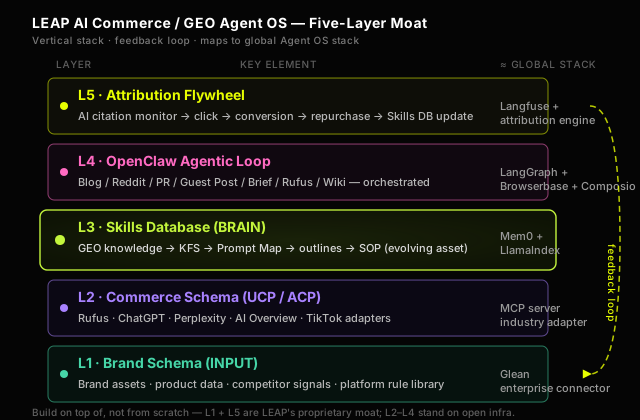
LEAP is not trying to build a general-purpose Agent OS. It is building a vertically-specialized AI Commerce / GEO Agent OS, and every one of its five internal layers maps cleanly onto a corresponding slot in the global stack. Brand Schema (L1) sits where Glean's enterprise knowledge connector sits — it ingests brand assets, product data, competitor signals, and platform rule libraries. Commerce Schema / UCP / ACP (L2) plays the role of an MCP-server industry adapter, translating outputs into the citation logic of Amazon Rufus, ChatGPT, Perplexity, Google AI Overview, and TikTok's social AI. The Skills Database (L3) is LEAP's brain — a Mem0 + LlamaIndex-style memory and knowledge layer expressed as GEO knowledge, KFS, Prompt Maps, outlines, and SOPs. OpenClaw (L4) is the agent runtime + action layer (LangGraph + Browserbase + Composio), and the Attribution Flywheel (L5) is the eval + observability layer, parallel to Langfuse plus a custom attribution engine.
Two of those five layers are the ones LEAP must build itself — and they are deliberately the two no infrastructure vendor will ever build for it. Brand Schema is a data-permission moat: the brand assets, the buying-cycle context, the platform-specific rule libraries, the competitor signals scraped under client authorization — competitors literally cannot replicate this, because they don't have the contracts, the access, or the years of structured ingestion. Attribution Flywheel is the most valuable asset of all, because it is what makes clients renew. The loop — AI citation monitoring, click tracking, conversion attribution, repurchase signals, Skills DB updates, next-round optimization — is what turns LEAP from a one-shot content vendor into a system that demonstrably moves revenue every quarter. Open infrastructure cannot ship this; only an operator embedded in the brand's commerce stack can.
For every other layer, the principle is "build on top of, not from scratch." LEAP integrates LangGraph for orchestration, Mem0 and Pinecone for memory, Composio and Browserbase for tools and browser actions, and Langfuse for observability — instead of re-inventing any of them. The engineering investment therefore concentrates exactly where it compounds: Brand Schema and Attribution Flywheel, the two layers that get richer with every client and every cycle. The middle three layers ride the open infrastructure wave; the top and bottom layers are where LEAP's IP, defensibility, and renewal economics actually live.
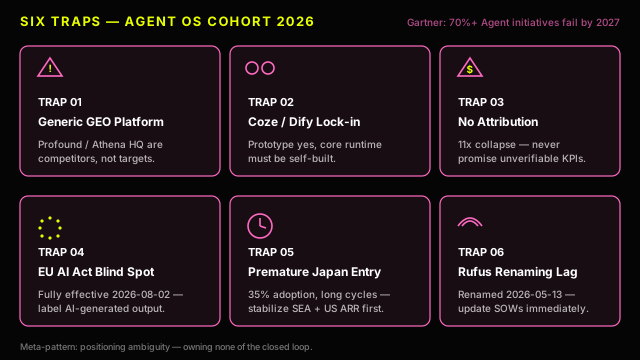
Across the cohort of Agent OS startups that have stalled or imploded in the past eighteen months, a recurring set of patterns has emerged — and most of them are unforced errors. 11x collapsed under the weight of inflated KPIs it could not attribute to real customer outcomes, ultimately facing legal exposure for claiming logos it had already lost. Artisan kept its narrative cleaner but never closed the execution loop, leaving customers with insight reports and no compounding asset. From those failures and the broader cohort, six traps stand out for any operator building in 2026. First, do not drift into being a generic GEO analytics platform — Profound and Athena HQ already occupy that lane, and the defensible moat sits in execution, attribution, and cross-border closed loops, not in dashboards. Second, do not let Coze or Dify replace a self-built runtime; they are excellent for prototyping and Chinese-market demos, but a custom Commerce Schema and data control cannot survive platform lock-in. Third, do not commit KPIs without an Attribution Flywheel underneath every promise. Fourth, do not underestimate the EU AI Act, which becomes fully effective on 2026-08-02 and mandates transparency labels on AI-generated content for any European-serving client. Fifth, do not enter Japan early — only 35% enterprise AI adoption, multi-quarter sales cycles, and expensive localization mean SEA and US ARR must stabilize first. Sixth, do not miss the Amazon Rufus to "Alexa for Shopping" naming window: the rename landed on 2026-05-13, most agencies have not updated their decks, and the awareness gap is a free authority signal for anyone who moves fast.
Underneath all six traps sits the same meta-pattern: positioning ambiguity. Each failed cohort member tried to be several things at once — a general GEO platform and a general Agent platform and a general workflow tool — instead of owning one closed-loop vertical end to end. The market punishes that ambiguity faster now than it did in 2024, because the cost of switching between general-purpose runtimes has collapsed and the cost of trusting an unverifiable Agent has risen. Gartner's prediction that more than 70% of corporate Agent initiatives will be cancelled or fail by 2027 is, read closely, a prediction about positioning discipline: the survivors will be the teams that picked one vertical loop, instrumented every step of it with attribution, and refused to expand horizontally until the loop itself was a durable, compounding asset. The six traps are not really six — they are six surface expressions of one root question, which is whether the company can answer, in a single sentence, what closed loop it actually owns.
The internal full version of this radar runs ~700 lines, covers nine chapters, lists 40+ named players with per-company decisions (Build / Buy / Partner / Watch), and maps every global stack layer to LEAP's internal layer. We're sharing the public distillation because the structural conclusion belongs to the whole AI Commerce industry, not just our roadmap. If you're a brand strategist, an Agent OS founder, or an infrastructure vendor reading this, the question we'd want you to take away is the same one we hold ourselves to: which single closed loop can you describe in one sentence, and which layer of the global stack are you trying to own? Email [email protected] with [AGENT-OS-MAP] in the subject line if you want a working call against your own stack.
Want to discuss this with the LEAP team, or get a working call against your own stack? Email [email protected] with [BLOG] in the subject line.