LEAP Agent OS Framework
The architecture LeapUnion ships to enterprises that need an Agent Operating System, not a chatbot — a Context Layer + Customized Harness Engineering + Business 360 Agent Apps + a Data Flywheel that gets sharper with use.
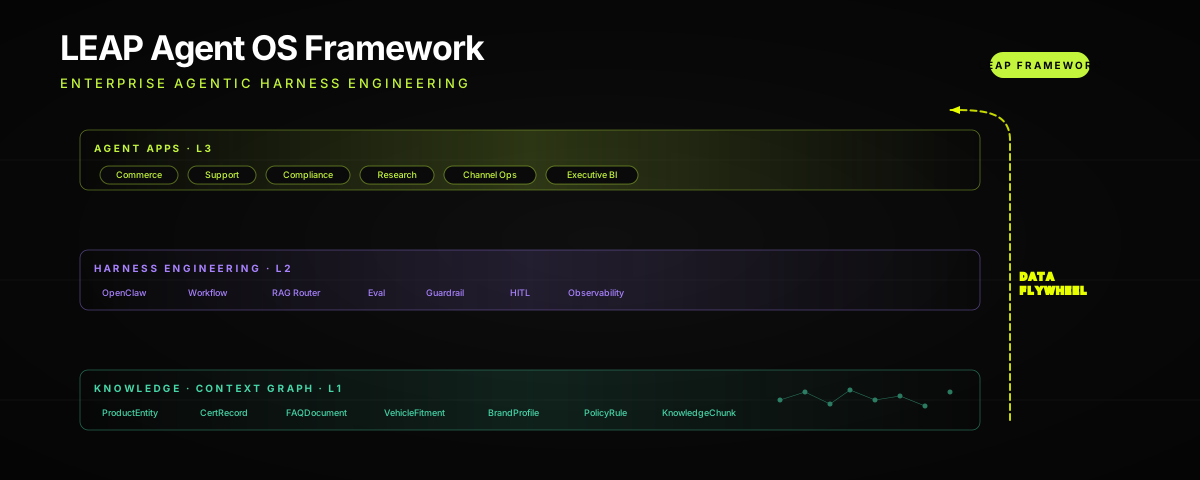
Not a single Agent — an Agentic Enterprise Infrastructure
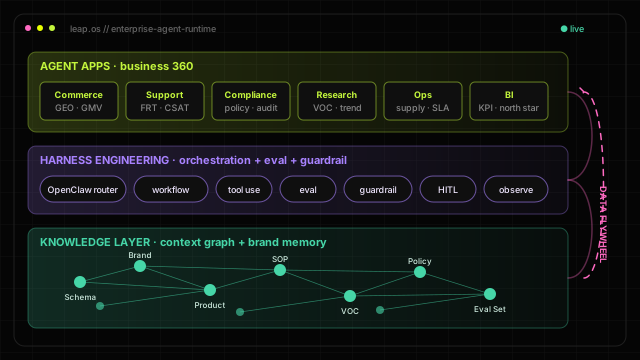
LEAP does not ship a single Agent — it ships an Agentic Enterprise Infrastructure, the operating substrate a Fortune-style business needs before any of its departments can safely automate. Four planes carry that infrastructure. A Context Layer turns the customer's documents, FAQs, certifications, product data and channel feeds into a governed cognitive graph — Schema, Brand Memory, Product Entities, SOP, Policy, VOC and Eval Sets — that every downstream agent reads from and writes back to. A Customized Harness Engineering layer wraps that knowledge in the runtime discipline enterprises actually procure: OpenClaw multi-agent routing, workflow orchestration, tool use, approval flows, guardrails, HITL checkpoints, observability and a continuous evaluation harness. On top of those two layers sit Business 360 Agent Apps — Commerce, Support, Compliance, Research, Ops, BI — each scoped to a named department KPI rather than a loose chat surface, with SoV, CVR, FRT, cycle-time and compliance-rate written into the contract. Closing the system is a Data Flywheel: every execution — every routed query, low-confidence escalation, conversion event and human override — re-writes the Skills DB, the Schema, the Eval set and the Playbook, so the OS measurably improves with use rather than degrading. The rest of this page walks through the four deployment layers, the six Agent Apps mapped to a 12-agent three-layer org chart, and the six-step delivery path that takes a client from audit to flywheel.
The 4-Layer Knowledge → Agent OS Stack
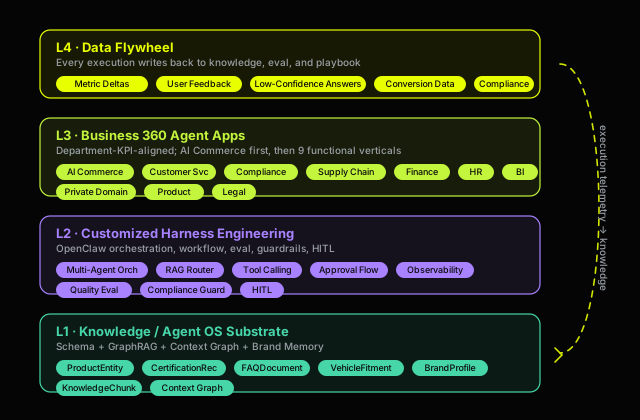
Most "enterprise AI" deployments treat retrieval as a bolt-on: a vector store stapled to a chatbot, with no shared substrate beneath it. Our 4-layer stack inverts that assumption. Layer 1 — the Knowledge / Agent OS — is the operating substrate, not an attachment. It encodes ProductEntity, CertificationRecord, FAQDocument, VehicleFitment, BrandProfile, KnowledgeChunk and a unifying Context Graph, so every downstream agent reads from one canonical model of the business. Layer 2, Customized Harness Engineering, wraps that substrate with the production-grade machinery agents actually need to run safely at scale: multi-agent orchestration, RAG Router, tool calling, approval flows, observability, quality evaluation, and compliance guardrails — the discipline layer that turns demos into systems. Layer 3, Business 360 Agent Apps, is the only layer the end user sees: department-KPI-aligned applications — AI Commerce first, then customer service, compliance, private domain, product, supply chain, finance, HR, legal, and BI — built as a coherent portfolio rather than nine isolated point tools.
Layer 4 is what makes the architecture compound rather than commodify. Every Agent execution is not just an output to a user; it is an update written back into the Knowledge layer, the Eval set, and the Playbook. Metric deltas, captured user feedback, low-confidence answers, conversion outcomes, and compliance events all loop back as structured signals — refining the Context Graph, retiring stale prompts, sharpening guardrails, and seeding new playbook variants. The result is a Data Flywheel: each week of operation makes the next week cheaper, safer, and more accurate, because the substrate itself is learning. Without Layer 4, an AI deployment plateaus at launch quality; with it, the gap between you and a copy-paste competitor widens every quarter. This is why we treat the four layers as one inseparable system — and why we refuse to ship the visible app layer without the three layers underneath it.
From Documents to Governed Knowledge Substrate
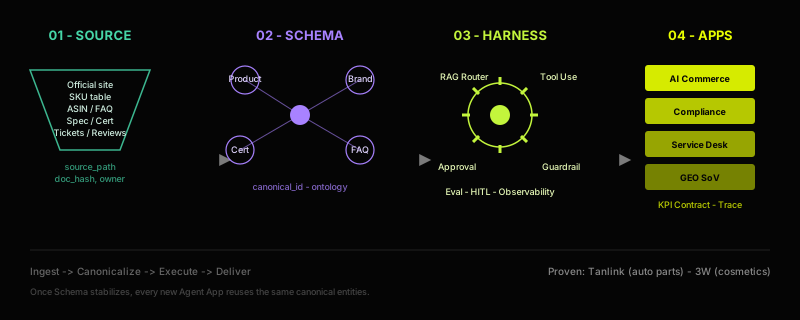
Deployment of LEAP's Agent OS proceeds in four disciplined layers, and the order is non-negotiable. Layer 01 — Source — ingests every artifact the enterprise already owns: the official site, SKU table, Amazon ASIN feed, FAQ pages, manuals, spec sheets, certifications, support tickets, reviews, and earned coverage on Reddit, YouTube, and PR. Each row is tagged with source_path, doc_hash, and an accountable owner, so provenance never decays. Layer 02 — Schema — is where most vendors cut corners and most projects later collapse. Instead of dumping raw text into a vector store, we canonicalize entities first: ProductEntity, BrandProfile, CertificationRecord, FAQDocument, VehicleFitment, and PolicyRule, each carrying a stable canonical_id and slotted into an explicit ontology. Layer 03 — Harness — turns the graph into something executable: a RAG router, workflow orchestration, tool use, approval flows, guardrails, evaluation, and observability via OpenClaw, Eval, and HITL. Only at Layer 04 — Apps — do agents appear, and every app is bound to a department KPI: conversion rate, response time, certification lookup time, SKU readiness, GEO citation share-of-voice. The LEAP-specific choice is to refuse the temptation to bolt agents onto unstructured RAG. Engineering effort spent canonicalizing entities up front is what gives every downstream agent the same ground truth.
Tanlink, our cross-border auto-parts client, is the proof. The brand carried more than 51,000 SKUs across vehicle fitments, certifications, and regional compliance rules — exactly the kind of catalog where naive RAG hallucinates a wrong bolt pattern and ships a refund. We ran Source, Schema, and Harness in that order before a single agent went live: ASIN feeds and supplier docs were ingested, ProductEntity and CertificationRecord were canonicalized against VehicleFitment, and the harness wrapped them with guardrails and HITL approval. Only then did AI Commerce Agent and Compliance Agent ship on top — each reusing the same entity layer. The 3W cosmetics rollout followed the identical pattern. The lesson is consistent: the harder you work on Schema, the cheaper every subsequent Agent App becomes.
Six KPI-Aligned Apps over a 12-Agent Three-Layer Org Chart
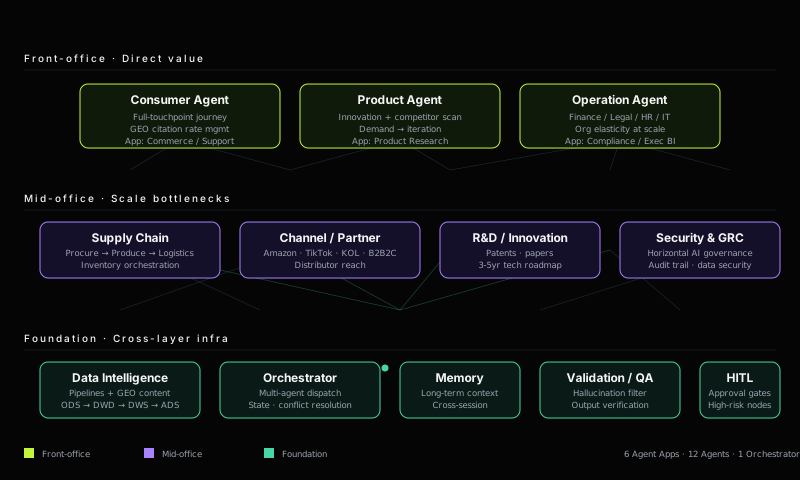
The visible-to-business slice of LeapUnion's Agentic OS is six KPI-aligned Agent Apps, each owning a small, defensible bundle of metrics. The AI Commerce Agent owns PDP CVR, Rufus Share of Voice, and AI Citation Share — every dollar of revenue lift trails back to one of those three. The Product Support Agent owns Deflection Rate, First Response Time, and Resolution Rate, turning the helpdesk from a cost center into a feedback channel. The Compliance Agent owns Cert Lookup Time and Violation Risk, the two metrics that decide whether a SKU stays on shelf in EU/US. The Product Research Agent owns Idea-to-SKU Cycle and Gap Discovery, compressing the path from VOC to listing. The Channel Ops Agent owns PDP Completeness, ACOS, and Stockout Risk across Amazon, TikTok Shop, and DTC. The Executive BI Agent owns Decision Cycle and Attribution Confidence — the meta-KPIs that govern how fast the other five can act.
Zoom out and those six apps rest on a twelve-agent, three-band org chart. The Front-office (Consumer, Product, Operation) creates direct value: full-touchpoint consumer journeys plus GEO citation management, product innovation plus competitor-to-iteration translation, and the finance/legal/HR/IT spine that gives the org elasticity at scale. The Mid-office (Supply Chain, Channel/Partner, R&D/Innovation, Security & Compliance) eliminates the four scale bottlenecks that always re-emerge as a brand grows — procurement-to-inventory, distributor and marketplace reach, the 3-5 year tech roadmap, and horizontal AI governance with audit trail. The Foundation (Data Intelligence, Orchestrator, Memory, Validation/QA, Human-in-the-Loop) is the cross-layer infrastructure every agent above shares: data pipelines plus GEO content production, multi-agent dispatch and conflict resolution, long-term cross-session persistence, hallucination filtering, and approval gates wherever a decision carries real-world risk.
The design principle is deliberately strict. Every business KPI maps to exactly one Agent App — no metric is owned by two apps, so there is no ambiguity about who moves it. Every Agent App rests on the same shared Foundation, so a new app does not re-implement its own data pipeline, its own memory store, or its own QA layer. And the Orchestrator is the single component that keeps the twelve agents from colliding: it dispatches tasks, mediates conflicts, and enforces HITL gates at high-risk decision nodes. This is what separates an Agentic OS from a pile of point-AI tools — clear KPI ownership at the top, shared infrastructure at the bottom, and one dispatcher in the middle that makes the whole shape composable.
Six Steps from Framework to Production Agent OS
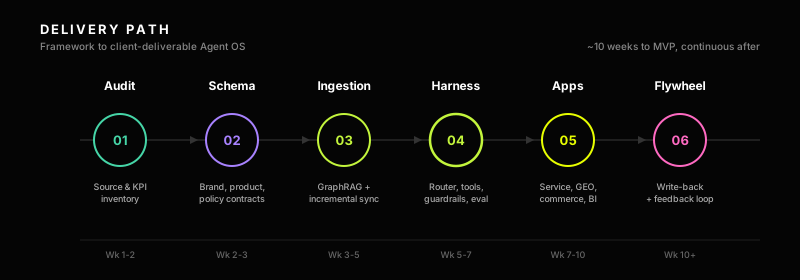
The path from framework to a client-deliverable Agent OS runs through six named steps, each producing a concrete artifact rather than a vague activity. Audit (01) yields an inventory: every knowledge source, business owner, permission boundary, freshness SLA, and KPI baseline written down in one place. Schema (02) yields the contracts — core models for brand, product, certification, FAQ, channel, customer, and policy that every downstream agent will read and write against. Ingestion (03) yields a living substrate: parsed and chunked documents with metadata, GraphRAG indexes, and incremental sync wired to source systems. Harness (04) yields the runtime — a multi-agent Router with workflows, tool use, guardrails, approval gates, and an eval harness, deployed once and reused by everything above it. Apps (05) yields the surfaces business users actually touch, rolled out by KPI priority: customer service, compliance, AI commerce, GEO, supply chain, BI. Flywheel (06) yields the learning loop — execution results, low-confidence questions, conversion data, and human feedback written back into the knowledge substrate so the next run is better than the last.
The order is not cosmetic. Audit and Schema before Ingestion is what eliminates garbage-in / garbage-out: you index against contracts, not against whatever PDFs happened to be on a shared drive. Harness before Apps is what makes later applications cheap to add — once the Router, guardrails, and eval are in place, the second app costs a fraction of the first, and the sixth costs almost nothing. Flywheel last is what compounds: the system gets smarter the more it runs, because every interaction returns to the substrate as labeled signal rather than evaporating in a chat log. Skip any step and the later ones get expensive; follow the sequence and each phase pays for the next. This is the same path LEAP runs for every client engagement; the Tanlink (cross-border auto parts, 51,000+ products) deployment is the public reference case.
Want this framework mapped to your own stack?
We run the Audit step as a paid 2-week engagement and return a written deployment plan against your knowledge surfaces and KPI contracts. From there, the rest of the path is a fixed sequence.
Email [email protected] with [FRAMEWORK] in the subject line.